
Pipe Sections up to 125 MM OD supplied in two half section. Sizes over 150 MM OD can be supplied in segments or two half sections as required.

Vila Rock Wool Polyurethane Pipe Insulation: Prefabricated Insulation with the Highest Thermal Efficiency for Piping
Preventing Energy Loss and Condensation Formation in Cold and Hot Pipes
Technical Product Introduction:
Vila Rock Wool polyurethane pipe insulation is manufactured using the most advanced polyurethane injection technology. The closed-cell structure of this insulation prevents moisture penetration and maintains long-term thermal efficiency. The product is manufactured in two types, PUR and PIR, and in various thicknesses according to pipe diameter and ambient temperature difference.
Key Advantages of Vila Rock Wool Polyurethane Pipe Insulation:
-
Extremely low thermal conductivity coefficient: 0.022 to 0.028 W/m·K
-
Quick and easy installation: semi-cylindrical design with immediate installation capability
-
Moisture resistance: prevents condensation formation on cold pipes
-
Chemical resistance: suitable for industrial environments with chemical vapors
-
Long service life: maintains thermal efficiency for more than 30 years
-
Environmentally friendly: free of CFC and HCFC
Main Applications:
-
HVAC systems: insulation of cold and hot water pipes
-
Building facilities: domestic water piping and central heating systems
-
Food and pharmaceutical industries: transfer pipes in sterile environments
-
Oil and gas industries: insulation of pipelines in refineries
-
Refrigeration systems: pipes of industrial cold storage facilities
Unique Features of Vila Rock Wool:
Vila Rock Wool, utilizing a fully automated production line and precise quality control, manufactures polyurethane pipe insulation with exceptional dimensional accuracy and uniform quality. Our commitment to international standards and comprehensive technical support guarantees customer satisfaction in both small and large projects.
Additional Details
Polyurethane insulations, briefly known as PUR, are considered among rigid closed-cell cold insulations.
Polyurethane is available in prefabricated slabs and can also be injected in bulk or sprayed on site. If polyurethane is sprayed (SPF – Spray applied Polyurethane Foam), special equipment is required and the presence of trained personnel is essential for the best results. SPF is mostly used in liquid transmission lines, tanks and vessels, cold storage centers and cold rooms, coolers and freezers. One of the main applications of polyurethane is the insulation used in sandwich panels.
In addition to insulation applications, polyurethane has many diverse uses in industry; for example, polyurethane is used in the manufacture of anti-wear elements such as anti-abrasion rollers, supports, and elements under compressive forces, rigid plastic parts, wheels, and so on. Polyurethanes used in different sectors differ from each other in density and chemical composition percentage. Polyurethane (PUR) insulations are very similar to polyisocyanurate (PIR) insulations and have almost the same properties and chemical composition.
Polyurethane insulations are available on the market in prefabricated board, pipe, and half-pipe forms. Polyurethane can also be injected or sprayed on site.
The ASTM C 1029 standard, titled “Sprayed Cellular Polyurethane Thermal Insulation,” covers topics related to various physical properties and applications of this material as thermal insulation in the range of -30 to 107 °C.
The above standard also discusses requirements for thermal resistance for 1 inch, compressive strength, water vapor permeance, water absorption, tensile strength, response to thermal and moisture aging, and closed-cell content.
The density of polyurethane is highly varied and changes depending on the type of need and application of the product.
Advantages of Polyurethane Insulations
- Very low thermal conductivity coefficient, highly suitable for industrial applications
- High resistance to erosion and corrosion
- High resistance to acids, solvents, and moisture
- High resistance to microbial, fungal, and biological contamination
- Capability of changing density from 30 kg/m³ to 700 kg/m³
- Suitable injectability and formability for insulating complex, bulky, or hard-to-reach shapes
Disadvantages of Polyurethane Insulations
- If injection-type polyurethane is required, a trained operator and equipment are essential.
- If the operating temperature exceeds the allowable temperature range, the thermal resistance of polyurethane decreases sharply.
- It is flammable and produces toxic gases if it catches fire. It is dusty (prefabricated polyurethane blocks and shapes are dusty and generate dust).
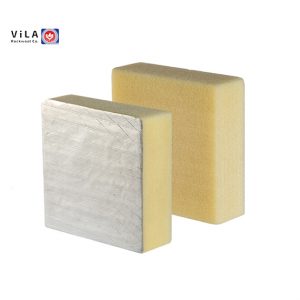
- description
-
Vila Rock Wool Polyurethane Pipe Insulation: Prefabricated Insulation with the Highest Thermal Efficiency for Piping
Preventing Energy Loss and Condensation Formation in Cold and Hot Pipes
Technical Product Introduction:
Vila Rock Wool polyurethane pipe insulation is manufactured using the most advanced polyurethane injection technology. The closed-cell structure of this insulation prevents moisture penetration and maintains long-term thermal efficiency. The product is manufactured in two types, PUR and PIR, and in various thicknesses according to pipe diameter and ambient temperature difference.Key Advantages of Vila Rock Wool Polyurethane Pipe Insulation:
-
Extremely low thermal conductivity coefficient: 0.022 to 0.028 W/m·K
-
Quick and easy installation: semi-cylindrical design with immediate installation capability
-
Moisture resistance: prevents condensation formation on cold pipes
-
Chemical resistance: suitable for industrial environments with chemical vapors
-
Long service life: maintains thermal efficiency for more than 30 years
-
Environmentally friendly: free of CFC and HCFC
Main Applications:
-
HVAC systems: insulation of cold and hot water pipes
-
Building facilities: domestic water piping and central heating systems
-
Food and pharmaceutical industries: transfer pipes in sterile environments
-
Oil and gas industries: insulation of pipelines in refineries
-
Refrigeration systems: pipes of industrial cold storage facilities
Unique Features of Vila Rock Wool:
Vila Rock Wool, utilizing a fully automated production line and precise quality control, manufactures polyurethane pipe insulation with exceptional dimensional accuracy and uniform quality. Our commitment to international standards and comprehensive technical support guarantees customer satisfaction in both small and large projects.Additional Details
Polyurethane insulations, briefly known as PUR, are considered among rigid closed-cell cold insulations.
Polyurethane is available in prefabricated slabs and can also be injected in bulk or sprayed on site. If polyurethane is sprayed (SPF – Spray applied Polyurethane Foam), special equipment is required and the presence of trained personnel is essential for the best results. SPF is mostly used in liquid transmission lines, tanks and vessels, cold storage centers and cold rooms, coolers and freezers. One of the main applications of polyurethane is the insulation used in sandwich panels.
In addition to insulation applications, polyurethane has many diverse uses in industry; for example, polyurethane is used in the manufacture of anti-wear elements such as anti-abrasion rollers, supports, and elements under compressive forces, rigid plastic parts, wheels, and so on. Polyurethanes used in different sectors differ from each other in density and chemical composition percentage. Polyurethane (PUR) insulations are very similar to polyisocyanurate (PIR) insulations and have almost the same properties and chemical composition.
Polyurethane insulations are available on the market in prefabricated board, pipe, and half-pipe forms. Polyurethane can also be injected or sprayed on site.
The ASTM C 1029 standard, titled “Sprayed Cellular Polyurethane Thermal Insulation,” covers topics related to various physical properties and applications of this material as thermal insulation in the range of -30 to 107 °C.
The above standard also discusses requirements for thermal resistance for 1 inch, compressive strength, water vapor permeance, water absorption, tensile strength, response to thermal and moisture aging, and closed-cell content.
The density of polyurethane is highly varied and changes depending on the type of need and application of the product.
Advantages of Polyurethane Insulations
- Very low thermal conductivity coefficient, highly suitable for industrial applications
- High resistance to erosion and corrosion
- High resistance to acids, solvents, and moisture
- High resistance to microbial, fungal, and biological contamination
- Capability of changing density from 30 kg/m³ to 700 kg/m³
- Suitable injectability and formability for insulating complex, bulky, or hard-to-reach shapes
Disadvantages of Polyurethane Insulations
- If injection-type polyurethane is required, a trained operator and equipment are essential.
- If the operating temperature exceeds the allowable temperature range, the thermal resistance of polyurethane decreases sharply.
- It is flammable and produces toxic gases if it catches fire. It is dusty (prefabricated polyurethane blocks and shapes are dusty and generate dust).
related post
-
- more information
-
- Review
-
Reviews
There are no reviews yet.


Reviews
There are no reviews yet.